


By overturning Casey, the court will send a clear message to state legislators that it is open season for them to pass blatantly unconstitutional laws in the hopes that the justices might reverse more precedents. Legislatures can be expected to pass laws barring companies from paying for out-of-state abortions, for example, and reversing well-established rights like gay marriage and even access to some forms of contraception.
These laws will be challenged in court, and in all likelihood they will ultimately be overturned. But with the anticipated weakening of precedent, lower courts have already started allowing unconstitutional laws to stay in place pending eventual Supreme Court decisions.
American business will be caught in the middle. Companies of any size can be expected to be affected by the coming conservative legislation and to be pressured by progressive activists to take stands against the states that pass such laws. Corporations will have no choice but to engage the hot-button social issues of our polarized time.
As much as most business leaders want to avoid the losing battle of navigating between threats from the right and the left, the new legal-political-cultural environment will repeatedly cast them into situations where state laws, their company’s stakeholders and the public force them into the fray.
In a typical situation, Republican state legislatures will be pushing corporate management from the right. Employees, especially at tech companies, will generally be a constituency pushing from the left, alongside progressive NGOs. For public-facing companies, there will also be pressure from consumers — which could come from left or right depending on geography and industry.
This new sort of environment in turn calls for a new corporate approach: one that begins with defining a company’s values and then determining how to apply those values in the face of inevitable criticism from stakeholders. Companies will find they must use ethical thinking to reason their way to decisions they believe in, employing principles they can apply consistently. Then they will use those principles to explain their decisions to stakeholders.
To see how this new world is evolving, consider an example that doesn’t even have to do with abortion: Texas’s so-called HB-20 law, which bars large social-media platforms from moderating content “based on viewpoint.” Effectively, that means the platforms wouldn’t be able to operate in Texas. If they were to stop trying to block nasty, offensive content, their services would become unattractive to many or most users — that’s a big reason why the platforms developed content moderation in the first place. Technically, they can’t just turn off their services in one state.(2)
In the past, when obviously unconstitutional laws were enacted, federal district courts immediately blocked them from going into effect. Whatever political gains legislators got from passing the laws were minor, brief and at most symbolic, because the legal system had rapidly and definitively rebuffed them.
The trajectory of HB-20 illustrates how the reality is changing. The law plainly violates existing First Amendment law. Corporations enjoy free-speech rights under the Citizens United precedent. It is also well-established free-speech doctrine that this includes the right not to be compelled to speak as well as the right not to be forced to associate yourself with speech that expresses a viewpoint you reject. Requiring a platform to allow user speech that it chooses not to display certainly violates the First Amendment as it has been understood for decades.
No court has ever held that the First Amendment does not protect social-media platforms. Justice Clarence Thomas, in a short concurring opinion in the Supreme Court’s refusal to hear a 2021 case, did suggest that the courts should consider treating social-media platforms as common carriers or public accommodations, thereby limiting their rights to exclude users or their speech. But one hint from one justice hasn’t usually been enough to make the lower courts ignore precedent — until now.
A federal district court in Texas initially issued a stay blocking HB-20 from going into effect. The court was following the traditional playbook for how the judiciary is supposed to respond to obviously unconstitutional new statutes: by prohibiting state officials from enforcing them.
But a three-judge panel of the US Court of Appeals for the Fifth Circuit broke the paradigm. Not only did the panel overturn the stay by a 2-1 vote, it did so without issuing an accompanying opinion. We know that one of the three judges disagreed with the others. That makes the decision all the more astonishing, as it is commonplace for a divided court to explain its reasoning.
The parties affected by HB-20 had to go to the Supreme Court on an emergency basis to ask it to reinstate the stay. By a 5-4 vote, the justices put the district court’s stay back in place. Justice Samuel Alito, joined by Thomas and Justice Neil Gorsuch, wrote an opinion playing out more of Thomas’s ideas and suggesting the law should change.(1)
The upshot is that this case is far from over. An unconstitutional law like HB-20 now gains much more public attention for the legislators who passed it — and over an extended period of time.
Each round of litigation is its own news cycle. The legal process can last for years. All of this is happening because the Supreme Court is telling legislators, lower courts and the country as a whole that its traditional respect for precedent is being radically altered.
Thirty years ago, Planned Parenthood v. Casey held, effectively, that although the swing justices were skeptical about the Roe decision, they would nevertheless uphold the law as a matter of precedent. The opinion signed by Justices Anthony Kennedy, Sandra Day O’Connor and David Souter framed the importance of stable precedent in an adage: “Liberty finds no refuge in a jurisprudence of doubt.”
The resulting message was that the Supreme Court would take precedent seriously, upholding even decisions they didn’t much like in favor of stability. That in turn sent a direct message to lower courts: If we, the justices, are not going to overturn precedent, then you certainly must not.
The Power of Justice Thomas
Reflecting the changed situation now, Thomas is emerging as one of the most powerful voices on the newly configured Supreme Court. He has always taken the view that precedent should count for little or nothing when he considers a decision to be legally wrong. His job, as he sees it, is to interpret the Constitution in accordance with original meaning — regardless of what the court has said in the past or the consequences for the future.
A large number of his former law clerks were appointed as federal judges when Donald Trump was president. They can be expected to ignore precedent, as Thomas has always done. (One of them recently issued an opinion striking down the Centers for Disease Control’s airplane mask mandate — a ruling that flouted judicial norms to such a degree that it shocked even many conservatives and libertarians who were otherwise opposed to the mandates.)
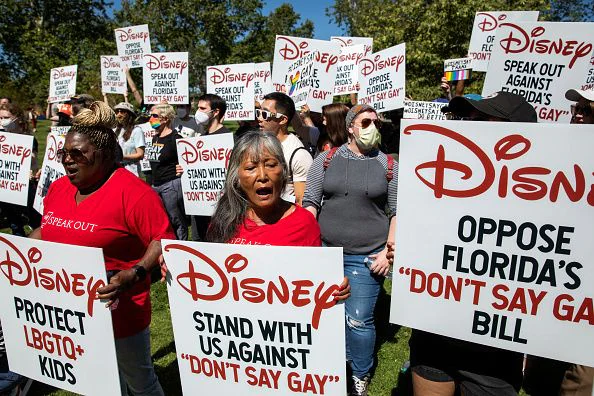
The new normal in the legal context is closely tied to the extreme polarization of the political environment. Conservative state legislators increasingly benefit from the symbolic effects of passing high-profile laws that attack well-known corporations. A recent example is the Florida legislature’s anti-Disney measure that was in response to the company’s opposition to Florida’s “Parental Rights in Education” law, known to its opponents as the “Don’t Say Gay” law.
Like HB-20, the Florida law is a blatant violation of the First Amendment — in this case, because it was overtly intended to punish a private actor for expressive speech. Yet Florida legislators knew that Disney would have to litigate to have the law overturned.
Each stage of the process will create fresh news. And each round of media attention will remind Florida voters that the legislators who supported the bill took a strong, culturally conservative stance against a major corporation — one whose name alone is enough to make headlines. The result is, again, that state lawmakers have a strong incentive to pass unconstitutional legislation for political gain, regardless of whether any of it ever goes into effect.
Overturning Casey will encourage legislators to enact other laws that challenge established constitutional rights. Lawmakers in Texas are already threatening to pass legislation targeting companies that pay for employees to go out of state for abortions. Corporate executives, they warn, could face criminal charges. The businesses could be forced to choose between paying for the abortions or being driven from the state.
Legislators Grab the Spotlight
State legislators will have parallel incentives to pass laws that vitiate the right to gay marriage and that ban forms of contraception used to induce abortions. I don’t expect the Supreme Court to reverse the Obergefell v. Hodges decision legalizing gay marriage or revisit Griswold v. Connecticut, the 1965 precursor to Roe that established the right to contraception. So it’s likely the court would eventually strike down any state measures that flout those two rulings.
But that will not matter to the legislators, who will be focused on the political points they can earn. Merely passing the legislation will make headlines. Some lower courts may well leave the laws in place pending Supreme Court review, as happened with HB-20.
A lot of time could pass while the validity of gay marriages and the availability of contraception are placed in legal jeopardy in a number of states. The result will be extended litigation, endless protests and more publicity for the politicians responsible for violating people’s basic rights.
Like it or not, and they won’t, corporations will be in the thick of it. They will have to struggle to protect employees’ rights while avoiding targeted sanctions. All parties involved have an interest in getting the private sector to take their side.
We are entering a substantially different era in which the courts, legislators, individuals and corporations will bump into one another in conflicts that are cultural, legal and political. And it’s just getting started with no end in sight.
More on the Supreme Court From Bloomberg Opinion:
• US Justices Are Looking More Like Politicians: Noah Feldman
• What’s Not Going to Happen After Roe Falls: Ramesh Ponnuru
• Supreme Court’s Leak Investigation Is Self-Destructive: Stephen L. Carter
(1) Disclosure: I was architect of Facebook’s Oversight Board and continue to advise Meta on governance issues.
(2) Justice Elena Kagan dissented from the stay without giving a reason. The best bet is that she doesn’t like emergency stays without a clear emergency. But because she didn’t say so in this instance, no one can be sure how she will vote if the case comes back to the justices as a full-dress challenge to the platforms’ free-speech rights.
This column does not necessarily reflect the opinion of the editorial board or Bloomberg LP and its owners.
Noah Feldman is a Bloomberg Opinion columnist. A professor of law at Harvard University, he is author, most recently, of “The Broken Constitution: Lincoln, Slavery and the Refounding of America.”
More stories like this are available on bloomberg.com/opinion
